
CRIT - AI SHIPPED PRODUCT
AI Design Critiques That Actually Know UX
Designers at early-stage companies don't have access to a senior design voice. Crit is the on-demand critique partner that fills that gap, upload a design, get feedback grounded in real UX principles, not vibes.
ROLE
Solo - design, prompt engineering & build
STACK
Claude → Lovable → Vercel + Microsoft Clarity
YEAR
2026
DURATION
Concept to shipped in 3 weeks, solo
4 min read
THE CONSTRAINT
The obvious version of this product was the one that fails
Language-based critique is imprecise; "improve the hierarchy" means nothing without seeing what the designer sees.
The obvious version of this product is a chat interface where you describe your design and get feedback. That version fails. The problem isn't the AI, it's the input format.
The harder problem was making the AI's output consistent, structured and actionable every time, not freeform prose that changed unpredictably between runs.
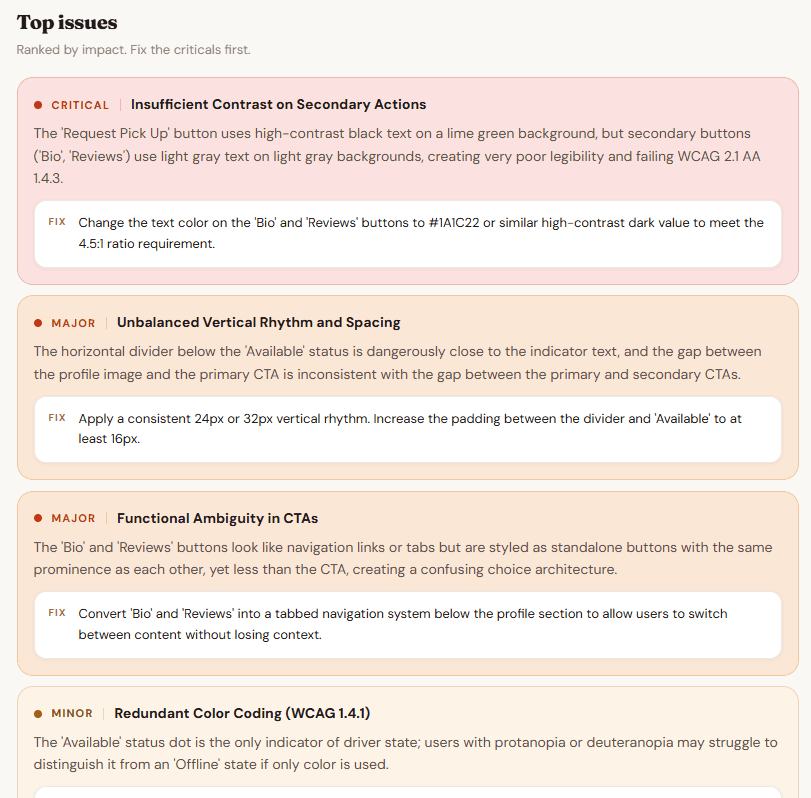
STRUCTURED CRITIQUE OUTPUT - SCORED, LABELLED, REPRODUCIBLE
3 KEY DECISIONS
Three calls that made the critique trustworthy
Each decision traded an easy default for the harder choice that made the output defensible, reproducible, and stable.
01
Encoding methodology into the prompt, not the persona.
The first version told the AI to act like a senior designer. The output was confident but inconsistent; good one run, generic the next. The alternative was grounding each evaluation dimension in a named framework: Gestalt for hierarchy, WCAG 2.2 AA for accessibility, Nielsen's heuristics for interaction. This made the critique defensible and reproducible, which matters specifically for a product where users need to trust the output enough to act on it.
02
One free critique before the paywall, not a time-based trial.
A 3-day trial works for tools people use daily. Designers don't critique designs every day; they do it at specific project moments. A time-based trial would expire before most users had a genuine reason to run a second critique. Usage-gating at one critique means the paywall appears at the exact moment of demonstrated value, not an arbitrary deadline.
03
Force the AI to return structured data, not conversational prose.
The temptation was to let the model respond conversationally and parse it downstream. The failure mode is obvious in hindsight: any variance in response format breaks the UI. Defining an explicit JSON schema in the system prompt and validating every field on return - clamping scores, sanitising labels, slicing arrays - made the interface stable regardless of model variance. The tradeoff is prompt length and token cost per call, which is acceptable at this price point.
THE AI-SPECIFIC INSIGHT
The prompt work that mattered wasn't about tone
“
When AI output feeds directly into a UI, treat the response schema as an API contract, not a suggestion.
The prompt engineering work that mattered had nothing to do with tone or persona; it was making the output structurally deterministic while keeping the qualitative reasoning sharp. The failure mode I hit early was conflating those two problems: I kept rewriting the persona to get better reasoning, when the actual issue was that inconsistent output format was making good reasoning invisible in the UI.
Separating the contract (what shape the response takes) from the methodology (what framework the reasoning applies) fixed both.
OUTCOME
Early signals from a product still in its first weeks live
3 wks
CONCEPT → SHIPPED
Solo, end to end: product thinking, prompt engineering, build, and deployment.
Own work
STRONGEST PULL
The weekly design-challenge card drew almost no engagement next to users bringing their own real designs.
The output quality question ("did this feel like a senior designer or generic AI?") is the signal I'm watching most carefully. Initial responses suggest the methodology-grounded prompt is doing real work; users are citing specific issues from the critique in follow-up DMs, not just acknowledging that feedback was given.
The thing that didn't work as expected: the weekly design challenge card, which I built to drive habitual return visits, gets almost no engagement compared to users who come with their own work. The pull of "I need feedback on this specific thing" is stronger than any content-driven hook I can create. That's a meaningful finding about the use case.
ONE THING I'D DO DIFFERENTLY
Watch real designers before writing a single line of prompt
Run five live critique sessions with real designers before writing the system prompt; watching where they felt the output missed would have saved two full prompt rewrites.
MORE CASE STUDIES
see everything I've shipped

Let's work together
ALONSO ROSADO
Designed this too, obviously.
CRIT - AI SHIPPED PRODUCT
AI Design Critiques That Actually Know UX
Designers at early-stage companies don't have access to a senior design voice. Crit is the on-demand critique partner that fills that gap, upload a design, get feedback grounded in real UX principles, not vibes.
ROLE
Solo - design, prompt engineering & build
STACK
Claude → Lovable → Vercel + Microsoft Clarity
YEAR
2026
DURATION
Concept to shipped in 3 weeks, solo
4 min read
THE CONSTRAINT
The obvious version of this product was the one that fails
Language-based critique is imprecise; "improve the hierarchy" means nothing without seeing what the designer sees.
The obvious version of this product is a chat interface where you describe your design and get feedback. That version fails. The problem isn't the AI, it's the input format.
The harder problem was making the AI's output consistent, structured and actionable every time, not freeform prose that changed unpredictably between runs.
STRUCTURED CRITIQUE OUTPUT - SCORED, LABELLED, REPRODUCIBLE
3 KEY DECISIONS
Three calls that made the critique trustworthy
Each decision traded an easy default for the harder choice that made the output defensible, reproducible, and stable.
01
Encoding methodology into the prompt, not the persona.
The first version told the AI to act like a senior designer. The output was confident but inconsistent; good one run, generic the next. The alternative was grounding each evaluation dimension in a named framework: Gestalt for hierarchy, WCAG 2.2 AA for accessibility, Nielsen's heuristics for interaction. This made the critique defensible and reproducible, which matters specifically for a product where users need to trust the output enough to act on it.
02
One free critique before the paywall, not a time-based trial.
A 3-day trial works for tools people use daily. Designers don't critique designs every day; they do it at specific project moments. A time-based trial would expire before most users had a genuine reason to run a second critique. Usage-gating at one critique means the paywall appears at the exact moment of demonstrated value, not an arbitrary deadline.
03
Force the AI to return structured data, not conversational prose.
The temptation was to let the model respond conversationally and parse it downstream. The failure mode is obvious in hindsight: any variance in response format breaks the UI. Defining an explicit JSON schema in the system prompt and validating every field on return - clamping scores, sanitising labels, slicing arrays - made the interface stable regardless of model variance. The tradeoff is prompt length and token cost per call, which is acceptable at this price point.
THE AI-SPECIFIC INSIGHT
The prompt work that mattered wasn't about tone
“
When AI output feeds directly into a UI, treat the response schema as an API contract, not a suggestion.
The prompt engineering work that mattered had nothing to do with tone or persona; it was making the output structurally deterministic while keeping the qualitative reasoning sharp. The failure mode I hit early was conflating those two problems: I kept rewriting the persona to get better reasoning, when the actual issue was that inconsistent output format was making good reasoning invisible in the UI.
Separating the contract (what shape the response takes) from the methodology (what framework the reasoning applies) fixed both.
OUTCOME
Early signals from a product still in its first weeks live
3 wks
CONCEPT → SHIPPED
Solo, end to end: product thinking, prompt engineering, build, and deployment.
Own work
STRONGEST PULL
The weekly design-challenge card drew almost no engagement next to users bringing their own real designs.
The output quality question ("did this feel like a senior designer or generic AI?") is the signal I'm watching most carefully. Initial responses suggest the methodology-grounded prompt is doing real work; users are citing specific issues from the critique in follow-up DMs, not just acknowledging that feedback was given.
The thing that didn't work as expected: the weekly design challenge card, which I built to drive habitual return visits, gets almost no engagement compared to users who come with their own work. The pull of "I need feedback on this specific thing" is stronger than any content-driven hook I can create. That's a meaningful finding about the use case.
ONE THING I'D DO DIFFERENTLY
Watch real designers before writing a single line of prompt
Run five live critique sessions with real designers before writing the system prompt; watching where they felt the output missed would have saved two full prompt rewrites.
MORE CASE STUDIES
see everything I've shipped
Let's work together
ALONSO ROSADO
Designed this too, obviously.